
Here's a thing that happens constantly. An agency's creative team pitches a client on a bespoke experiential concept. The client loves it. The room is electric. Then the pitch team walks out, looks at each other, and asks the question they should have asked before the meeting: how do we actually build this?
The answer they find, almost every time, is one of two things. A software vendor who says yes but means 'we'll find the closest template and adjust the color scheme.' Or a production house that can build the physical elements but has no platform to power the digital layer. Neither of them can do what was actually sold in that room. And the agency is left managing a gap between what they promised and what the market can deliver.
The reason that gap exists is structural. Enterprise event tech companies have spent the last decade standardizing their platforms precisely because customization is perceived as expensive, risky, and hard to QA at scale. When you start customizing, one change breaks something three steps downstream. Most platforms decided the safer answer was to stop customizing. So they did. And they called it a product strategy.
Gramercy Tech made a different call.
<span class="gt_body_paragraph_bold">We built a platform that's designed to be customized, which means our development team doesn't flinch when an agency walks in with a slide deck full of ideas that have never been built before.</span>
It's an infrastructure decision that took years to make correctly. When an agency comes to us and says 'we promised the client this,' the answer is almost always yes.
The other thing worth knowing: we iterate. We don't build it once, hand it over, and hope for the best. The experience evolves as the brief sharpens, which means agencies don't have to be afraid of selling something ambitious. The risk of the gap between the pitch and the deliverable narrows considerably when the build partner is in the room from the beginning.
Let's talk about specs.
{{gt_blog_post_customization_button_1}}
<span class="gt_blog_post_subheader">Watch Seek, our AI scavenger hunt, run in the wild.</span>
Everything we've said about customization applies to Seek too. The scavenger hunt mechanic is ours. The game logic, the prompts, the scoring structure, the way it directs attendees toward the people and places you actually want them to find: that's built specifically for each client. No two Seek deployments look the same, because no two events have the same objectives.
The product video shows what it looks like when it's running at scale: live leaderboards, Gemini-powered AI validation, competitive energy sustained across a full event day. If you're thinking about what this could do for a client's next conference, trade show, or SKO, this is the two-minute version of that conversation.
{{gt_blog_post_customization_button_2}}
<span class="gt_blog_post_subheader">Two Builds. Zero Templates.</span>
<span class="gt_body_paragraph_bold">The Global Welcome Wall</span>
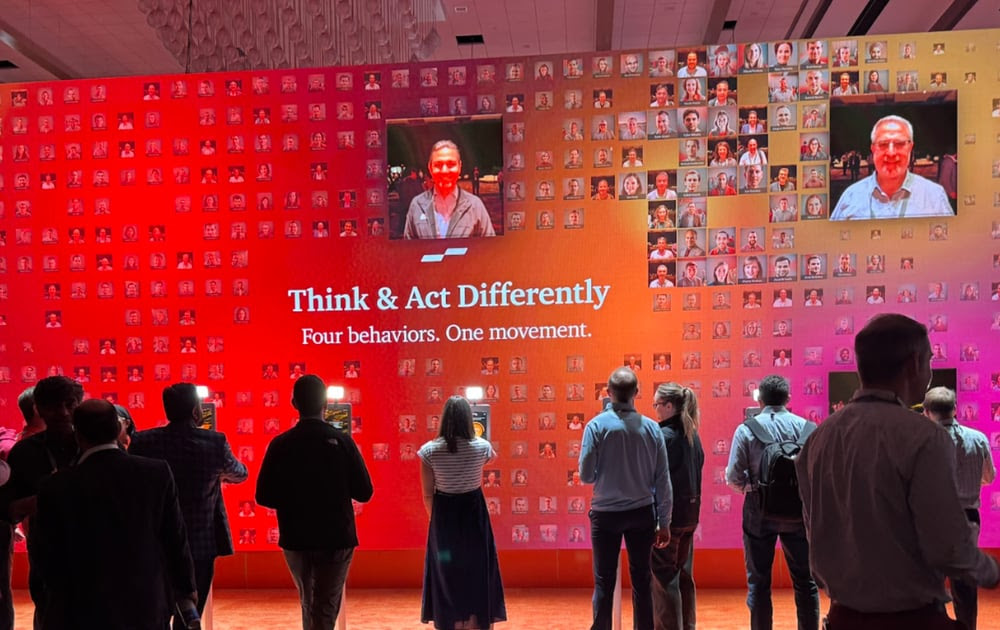
A global company wanted their internal event to feel like what it actually was: a room full of people from everywhere on earth, connected by the same organization. The brief was specific. A large-format map in the center. Attendees walk up, choose their country, enter their name. A photo appears. The country lights up, fills in, and the map builds in real time as the room fills. Their creative team had the slides. Nobody had the build.
We built it entirely to spec, incorporating the client's visual identity throughout and engineering the interaction flow so the experience was intuitive for attendees without any instruction. By the end of the event, the map was a live visual record of the organization's global footprint. The client's creative team looked brilliant. Which was exactly the point.
<span class="gt_body_paragraph_bold">The Pharma Patient Pathway</span>
A pharmaceutical group had a concept for their sales reps that needed to thread a regulatory needle: demonstrate the human impact of a drug without making claims that hadn't been approved. Their creative team had worked through the compliance layer and had a process approved. What they didn't have was anyone who could build it.
We built a kiosk-based patient pathway experience where reps walked through an individual patient's story, how the drug had changed their life, and what they were now able to do. At the end of the pathway, an AI portrait placed the patient in an activity that would have been impossible without the treatment. The reps weren't just learning about the drug's benefits. They were experiencing the outcome in a way that made the benefit personal and memorable. Built entirely within the approved compliance framework. Delivered on time.
{{gt_blog_post_customization_button_3}}


