
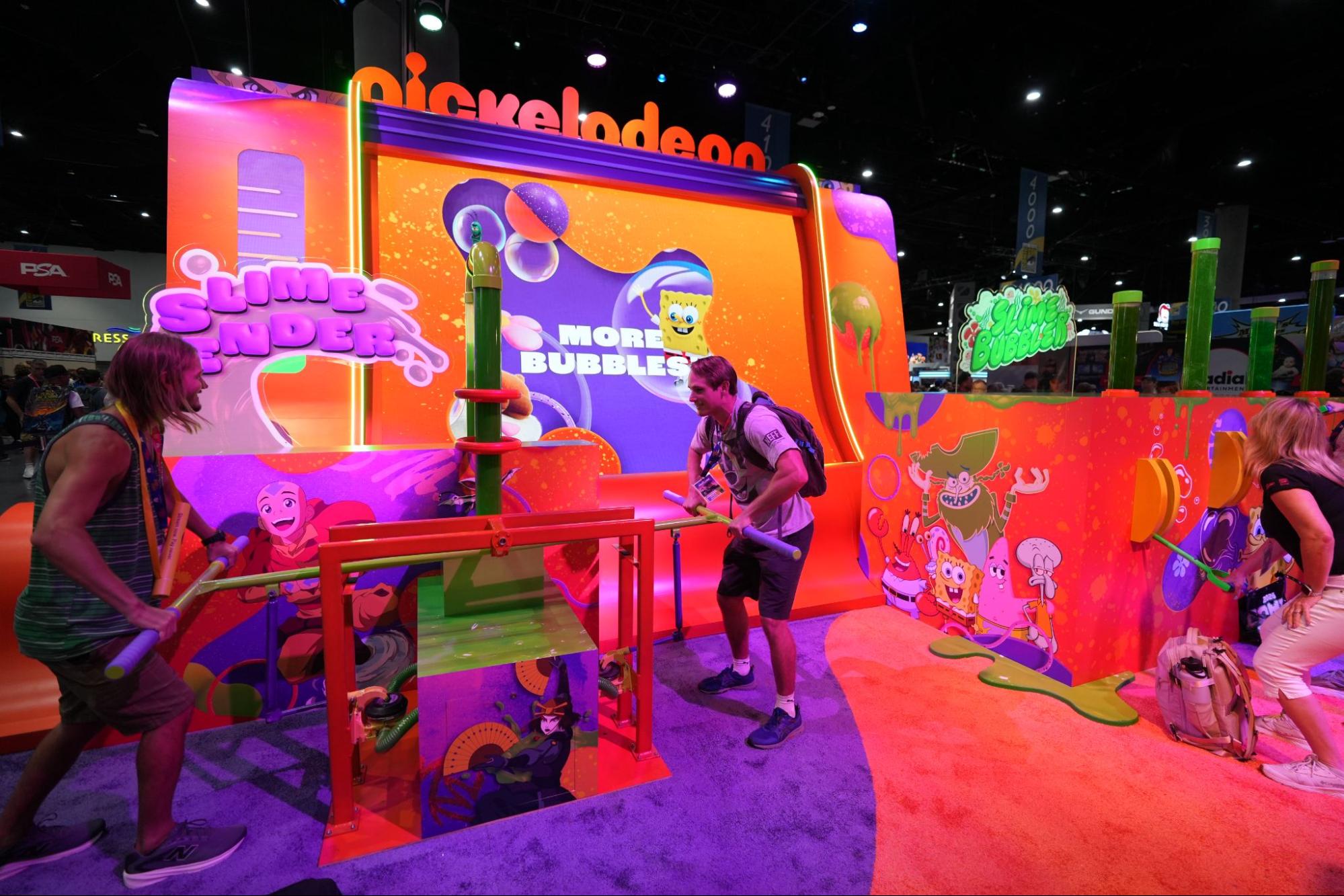
Watch a trade show floor long enough and you'll notice a pattern. People will skip the booth with the best swag. They will walk right past a demo that took months to build. But show them a game with a score attached, and something changes. A line forms and phones come out. Somebody's coworker gets pulled over to watch.
Reaction games have become a fixture at events for exactly this reason, and reflex challenges like Reaction Attraction and Batak Pro are turning up everywhere from trade show floors to brand activations. Catch the falling stick, hit the lighting sequence, beat your own score. Simple mechanics with instant feedback. No instructions required.
That last part matters more than it sounds like it should. Nobody has time at a conference to fundamentally learn a new system. A game that requires zero explanation removes the one thing that keeps people from engaging in the first place: friction. You see it, you get it, you're engaged.
We think about this constantly with Seek, our AI-powered scavenger hunt platform. The mechanics look different from a baton drop or a light-up target, but the underlying psychology is the same. Give someone a clear, immediate way to participate, and they will. Give them a way to see how they did against a friend, a colleague, or a leaderboard full of strangers, and they'll try again.
It's not really about the game itself, but what the game unlocks. A reaction challenge works because it turns a passive attendee into an active one in about four seconds, and once someone is active, they remember the experience differently. They're not recalling a pitch. They're recalling a feeling, a small rush of competition, the moment their score popped up on a screen.
That's the part brands often underestimate. Passive content gets forgotten. Participation gets carried home, told to a coworker, posted to a personal feed. When UPS deployed Seek across an internal event, participation ran close to 35 percent with zero manual adjudications needed, which tells you something about what happens when a game removes friction entirely: people don't need to be convinced to play. They just play.
There's also a social layer worth naming. A reflex game draws a crowd not just because it's fun to play, but because it's fun to watch. Somebody catches six, the next person wants seven. That same dynamic shows up inside Seek, where hunts are built around discovery and shared moments rather than solo scrolling, so the energy of one player pulls in the next.
Short-form video didn't invent this instinct, but it sharpened it. When someone sees a reaction game clipped and shared online, they arrive at the event already primed to try it themselves. The same holds for scavenger hunt content, badge reveals, AI portrait moments, anything visual enough to travel outside the room it happened in. If an experience is worth filming, it's usually worth building around.
The trade show floor is loud. Every booth is competing for the same six seconds of attention. What actually cuts through isn't more noise. It's a reason to stop, a reason to try, and a reason to want to beat your own score the next time around.


